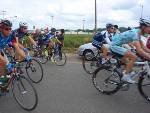
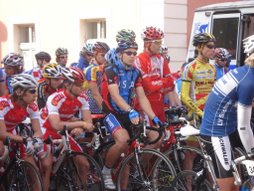
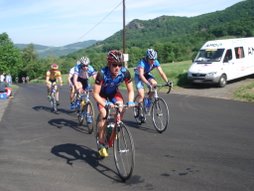
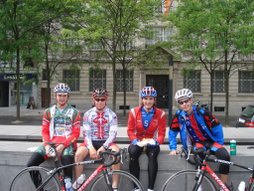
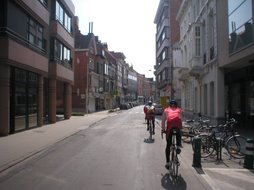
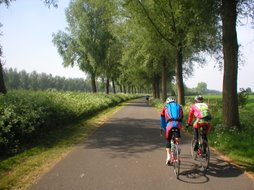
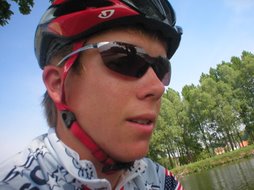
This past weekend we competed in a race called Ronde van de Vlaamse Ardennen. This race was a three day stage race in the Ardenn section of Belgium. This race was nice because each start was only an hour away from Izegem, so we were able to eat breakfast, lunch, and dinner at the team house. Plus, my parents, and sister, flew in last Friday, so they were able to watch the race. It was great to have a couple people cheering for team USA. There are a lot of people that cheer for the riders in general, but very few actually yell “Go USA!”
Stage One: Michelbeke -This stage consisted of seven laps on 15k loop with the Berendries climb on the beginning of each loop. The climb was fairly short, about 600 meters, but it was pretty steep. This is the kind of climb that Belgians thrive on: steep enough to hurt people on, but short enough where raw power is the best and endurance and weight play no part. After the climb the course circled through a town with wide streets where the buildings protected the riders from the wind. A cobbled descent and some rolling hills took the riders back to the finish. The weather wasn’t bad, with only a few sprinkles coming on and off throughout the race.
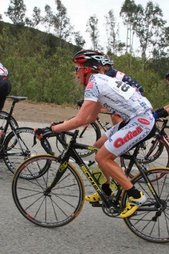
I got a horrible starting position because they kept moving the starting line further and further back. I hung out in the back for the first couple laps to check out the course and find which lines were fastest around the corners. Europeans are horrible “cornerers.” Plain and simple, they just suck going around tight city corners. Instead of flowing and pedaling through corners, the Euros prefer to take horrible lines, slam on the brakes, and then sprint like crazy to regain their speed. So I have found it useful to take the inside line, hit it really hard, either take the curb (making sure not to clip the pedal) or hop on to the sidewalk. This enables you to pass a lot of riders, while getting the usually European yell or grunt. Yelling is a major part of the European peloton. Everything from grunts, cuss words, and screams, yelling is used to defend your position, advance your position, and point out the faults of other riders. When you are the one getting yelled at, you can usually ignore it, or (my favorite) give the “yeller” a smile. This infuriates them. Once you can put the yelling out of your head, it seizes to intimidate you and you can ride much more effectively in the pack. A couple of attacks began going off the front and the pace began to quicken. On the fourth lap, I made a concerted move up through the field, and by the time we peaked on the climb on the fifth lap, I was positioned in the front. The wide roads of the race (which suite American riders) made it easier to move up. I went with a couple of attacks, but nothing was really getting to far away. On the sixth time up the climb I followed some riders and we opened up a nice lead, however this attempt faltered when riders began to refuse to work. The pack regrouped and I began fighting to stay at the front. The seventh lap came around and at the top of the climb, a group of 11 riders managed to slip off the front with some helpful blocking provided by their team mates. The final run into the finish was crazy, filled with riders locking bars and hitting hips. This is a point in the race that I am still not used to. You can find this aggressiveness in America, but it is only between a couple of guys. Here, 70 guys are left fighting and shoving their way to the front of the field. A last minute attack to bridge to the breakaway took a couple more riders off the front, including one of my team mates. I moved to the front of the field and blocked to the best of my ability: braking ever so slightly, taking guys into the curb (which is pretty fun), and following counter attacks. The attack with my team mate failed and I was consumed by the pack. I ended up there, tied for 12th with 90 other riders.
We started the race with five riders. One rider crashed out, and two riders finished off the back, leaving two of us to finish in the field.
Stage Two: Erwetegem- The course consisted of ten laps on a 10.2k loop. This course was rolling, with no climbs, and much more vulnerable to winds. The roads were narrower, and a cobbled road took the racers to the finish. Overcast skies luckily provided no rain.
Another horrible starting position put me at the back of the pack, but I quickly made my way to the front because I knew the small roads would stretch the 140 rider pack, making it difficult, and much longer, to move up. Again, for the first couple laps, I just watched and learned where to ride to get the best lines around corners and around obstacles. The roads we race on are subject to rolling closure, so cars are required to pull to the side. This makes things difficult because on one lap you may find a stretch of road where you can swing to the edge of the road and make your way to the front. On the next lap, you could be coming around and have a truck or car greet you on your “pre planned move up section.” You have to be paying attention to everything: maintaining or advancing your position in the pack, watching for cars, watching for round-a-bouts and other obstacles, and especially crashes. So for the usually two hours and forty-five minutes it takes to complete the race, riders get very little if any time to rest. The only way to get rest, and I am quickly learning this, is to be very efficient and smart in the pack. The laps added up, and at some point a breakaway managed to get away and put a minute between themselves and the pack. Probably because I wasn’t paying enough attention, or because the announcer only speaks Flemish, but I was not aware that there was a break up the road. We were told by our director that the race would blow apart on the third stage, so I was saving myself for the next day. The break managed to stay away with some of the riders putting 45 seconds more on our team. I finished the loops with the pack.
We managed to finish three guys in the pack, with only one rider finishing off the back.
Stage Three: Opbrakel - The course consisted of four laps of a 10k loop and then five laps on a 15k loop. The 10k lap contained half of the major climb of the day, and then a long, fast downhill to the finish. The 15k loop dropped the riders to the bottom of the climb, then pushed them up a “tree tunnel climb” to the top and then down the same downhill as the 10k loop and back to the finish. This climb was about 2ks, but it wasn’t very steep. However, it suited American climbers much more than Belgian climbers. The weather was cool, but luckily the rain stayed away.
The team manager told us to get in the breaks today, so that is exactly what we did. The first four laps came by pretty quick, with a 10 man breakaway going up the road, containing one American rider. The fifth lap came around, and the break had a minute lead on the pack, and I was getting a little worried that I had missed the winning break. So I moved to the front and began going with some attacks. After a couple hard efforts I managed to find another rider to work with. This kid was strong enough to take the lead on the hills, and then I would pull through on the tops and the down hills. We were flying. A couple kids managed to grab our wheels, but I didn’t care, as long as this kid and I worked together we would reach the break in no time at all. It was great seeing the lead car, and then managing to get close enough to the break to have the Shimano car pull to the side so that we could complete our “bridge.” We now had a lead group of about 15 riders, with two Americans…. The race was looking pretty good. The guy who shared the work with me and I went to the front and began to lead the group up the climb. I had no problem leading the climb, and then got into a comfortable tuck for the downhill. We reached the corner of the course where it flattens out and begins to head back to the climb. I pulled through, and then no one was there. I looked back and saw everyone on my wheel. I don’t mind having one or two guys on my wheel, but 14, that was not going to work. I zigzagged on the road, and tried to get the guys to pull through and keep the rotation going. No one was really interested in working except for a couple of guys. Why they wouldn’t work, I don’t know, I truly think that if everyone pulled through, we could have held the lead and finished off the front. Unfortunately, the Shimano car began blaring its horn while trying to pass us, meaning that the peloton wasn’t far behind. We were at the base of the hill and I did a last ditch effort to stay off the front as a couple of riders from the pack came up to join to me. We powered over the climb, and then were joined by several other riders on the downhill. The peloton was basically on our heels as we turned around and headed back toward the climb. Attacks were going up the road and then back as we headed to the climb with three laps to go. I saw another of my team mates, David, go with one of the attacks. I watched to make sure that his group got up the road, and then bridged up to it. We hovered off the front until the base of the climb. David and I took the lead and powered up the climb, trying to cause as much “pain” as possible. I have to say it was pretty cool having two American riders lead the pack up the crowded climb. We brought the group over the top and then were consumed by the pack on the downhill. It was that this point that I realized how helpful the downhill was for the bigger guys. We could drop the larger riders on the climb, and bring the group down to about thirty riders, but those riders that were dropped could use the downhill to bridge back up. With two laps to go, everything was together, and I managed to stay at the front and continued to go with the attacks. Nothing proved successful, and with one lap to go I was back to fighting for a front position in the pack. The final downhill to the finish was absolute chaos. Bars and shoulders were hitting, guys were hopping onto bike paths, and shoving their way through the center and up the sides to the front. I maintained a good position until the final corner, when I was supposed to get up and sprint, but my legs refused. I ended up finishing in the middle of the pack. All I need was one second on the peloton to move up into the top fifteen. Instead I tied with 70 other riders.
Three of us finished race. I think the director was pretty happy with our performance, USA was represented in every attack.
My dad got to ride in the team car on this final day, and he was completely stoked. He had a great time, and apparently talked and asked a lot of questions. Our masseuse said that he was very excited. My mom and little sister were on the side of the road cheering on every lap. It was awesome having my family here to cheer for me. You never want to race badly in front of your parents, so I think I performed better this weekend because of them.
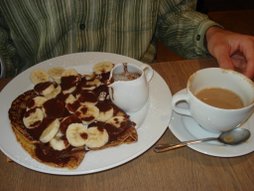
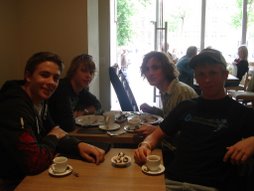
After these races, all the riders’ legs are dead. Everyone just wants to sit around and either watch TV or sleep. Crepes or waffles or chocolate are eaten as rewards for completing another race. The U-23 guys get to go down to the town square and drink some beers for celebrations. Juniors aren’t allowed that privilege, but next year…
Tuesday, May 29, 2007

Monday, May 28, 2007
Not Bad...
Yesterday was spent in the pack, fighting for positions. It was too flat yesterday to suit me. Danny, David and I finished in the pack. Today, there are more climbs, so I will try and get in a break. I think eighty of us are tied for 12th, so I need to get off the front.
Saturday, May 26, 2007
Its About Time...
This weekend we are competing in the Tour of Southeast Flanders. The race covers a lot of the roads used by the Tour of Flanders. Yesterday was finally a good day for me where just about everything went right. I am finally getting the hang of the European peloton, and spent most of yesterday in the top 30 riders (where I should be). I was in a couple of attacks, but nothing panned out. By the time the last couple k's came, Danny Summerhill attacked while I blocked for him. Unfortunately the move didn't work and Danny and I are sitting somewhere in the top forty. It just felt good to have a good day, where I could go with attacks and not have to worry about holding on to the back of the peloton.
The race is from Saturday to Monday, and I will keep everybody updated on how it plays out. Next week I will post a more descriptive account.
The race is from Saturday to Monday, and I will keep everybody updated on how it plays out. Next week I will post a more descriptive account.
Wednesday, May 23, 2007
One Rider's Loss, Is Another Rider's Gain...
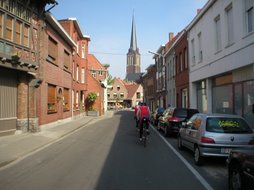
Finally a warm and sunny day has passed through this town. The California weather finally showed up, a couple weeks late, but at least it is here. Hopefully it won’t be too quick to leave. Its great not having to bundle up to go for a ride. Since there was no threat of rain, we road further out of our “comfort zone” of nearby cities and ventured into the Belgian country-side toward France. Passing patchwork farms, hedge groves, and the occasional church steeple in the distance, today’s ride was good reminder as to why I ride bikes. It was one of those perfect rides that you dream about in the States while you are at work or school.
The unwanted sickness is slowly passing out of the house. If one person gets sick here, it usually spreads from one person to the next. The trouble is, everyone wants to keep riding, so the sicknesses take a while to end.
The past couple nights have been great because I am the only one in my room. There is nothing like having your own room- you can go bed earlier, you don’t have to worry about mixing up clothes (since we all wear the same jerseys), and you don’t have to listen to the MTV channel on the TV (which I liked for the first day, until I realized that they played only ten songs over and over). Usually there are four guys to a room. Two of the guys in my room flew back to the States, and the other guy is in the hospital with a broken rib, collar bone, maybe jaw, busted teeth, and maybe a broken wrist. He crashed really hard, and upon seeing him, I prayed that nothing like that would ever happen to me. His season is over, and there is no telling when he will be back riding. We bring him magazines and Coca-Cola, and hang out with him as long as possible. He says the Belgian hospitals are brutally boring, but the nurses are hot, so…. you know….
We are all just trying to get our legs rested up, which takes much longer over here it seems like, and preparing for the next race.
Monday, May 21, 2007
Learning The Hard Way.....
When you first start racing your bike, you have to learn the ropes, as with any other sport. However, unlike other sports (except car racing, skiing, sledding, and maybe a couple other sports) you don’t risk crashing going 70+ k’s an hour. So when you first begin racing, you have to learn how to corner the bike correctly, how to hold your line, how to handle yourself in a pack, and so forth. You move your way up through the categories (Cat 5 being beginner and Cat 1 being pro). Once you make your way up to Cat 2, you begin to think that you have pretty good bike handling skills… until you come to Europe.
By far the hardest thing to adapt to while racing over here is learning to hold the wheel in front of you. You have to fight tooth and nail to be at the front of the pack in these races. In the States you can move up in the field extremely easily because the fields are smaller and fewer people are trying to be in the front. Over here, the fields are three times larger or even more. Plus, there are at least two kids on each team that have the capability to win the race. So instead of their being a couple of people having the power or skill to win a race like back in the States, you now have sixty kids that are fighting for the leaders jersey. Their aggression to stay at the front of the group is something that I am still trying to learn. In order to succeed in this type of racing I need to learn how to hold the wheel in front of me. Basically, get down and dirty….
So for the past three days I have been in the Netherlands competing in a three day, four stage race known as Axel.
The food and the accommodations for this race can be considered to be five-star compared to the “stuff” we received in the Czech Republic. All the teams went to a hotel where the racing officials fed us. Upon our first trip to the food court, we noticed large kegs in the line for the food. Our first thoughts were “Yes, this should be interesting.” To our disappointment, the lids were taken off the kegs and pasta was served to us.
First Stage: This stage contained one big loop, and then three finishing circuits. The terrain was flat as a pancake with two, one k sections of cobbles. The finishing circuits contained another stretch of one k cobbles. The race totaled 107 k’s.
We got to the line forty five minutes before the race started to get decent starting positions. So warming up for these races was out of the question. We actually considered bringing lawn chairs and sitting in them while we waited, maybe bring a stereo as well. So after a long time of sitting on the top tube of my bike, which gets pretty uncomfortable, the race was finally off. The wide street that the race began on quickly turned into small country roads after a couple tight twists and turns. We were told to stay at the front, and quickly realized why. With a 180 riders on one lane roads, moving up was virtually impossible, after a few mid-pack crashes, I found myself with support cars on my rear wheel, and about 179 guys in front of me. This was definitely not where I wanted to be. Luckily the attacks were starting at the front, and the pack was beginning to get strung out due to the “never-ending” cross winds. The gods of cycling must enjoy seeing the racers struggle against the winds and rain of Europe. Once the pack is strung out, my only opportunity of moving up presents itself. You say goodbye to the minimal draft you receive from the rider in front you, dive to the open side of the road and move your way up the pack trying to keep away from other riders to prevent them from drafting you (show no sympathy). It is unrewarding work, making your way up a line of 180 riders takes a lot of work and little gains come from trying to attempt it. Putting as many riders as you can between you and the support vehicles is important, and the satisfaction of knowing that if you get dropped and there are riders behind you that may be able to close the gap is the only reward you get for trying to move up. Unfortunately, no matter how many riders I put behind me, there always seems to be a crash in front of me. At the turn leading to the first cobbled section, a nice crash involved a group of riders at mid pack, separating the field, and I found myself chasing to get back with the leaders. At this moment, I found that I hate cobbles. Everything about them I hate. Since I have very little experience riding on these stones “from the pits of hell” I did not do a good job riding over them. I went back and forth across the narrow road trying to find “the sweet spot,” but to no avail. With my head down and pedaling as hard as I possibly could, I looked up in time to see a Dutch rider easily pass me. He was sitting up, hands on the top of his bars, apparently cruising and he just flew by me. The guy had to of had thirty pounds on me, and all I could do was watch as he pedaled me off his wheels. I would never see the leaders again after this point. I fought hard for about 50k, flowing in and out of the caravan, hoping that the pack would slow or a big crash would happen. Neither occurred and I soon found myself in a chase group. I happened upon a tough choice to make while in this group: I could either continue to ride hard and hope to catch back on to the group and limit the amount of time damage in the overall GC or I could sit in the back of this chase pack and save my legs for the TT and other stages. I opted for the second decision, mainly because I could tell that my legs weren’t recovered from the Czech, and that my cold was slowly getting worse throughout the week. So I finished about eight minutes down on the lead group. A disappointing first stage, but you have to keep your moral high because there are still three stages left.
We started the race with six riders. We lost three riders in this first stage. One pulled out due to sickness, and two crashed out.
Stage Two A: This TT consisted of a 7.8 k loop with several tricky turns. The wind was never at the rider’s back, it was either a cross wind or head wind.
I am finding that I am enjoying the TT’s more than the road races because you don’t have to deal with the crashes and mishaps you find in the peloton. I wished that we had gotten there earlier, but you can’t really tell the coaches what to do, so I couldn’t get the full warm up I needed. For a short TT you have to be completely “hot and ready to go.” As soon as I settled in I could tell that my legs still felt heavy, but I still tried my best. I ended up finishing fortieth. This was a respectable finish, but not exactly what I had wanted.
Stage Two B: Again, the course consisted of one big loop and then three finishing circuits. The finishing circuits contained the same stretch of cobbles from the finishing circuits of the stage before. So the good lines had been discovered and well warn. The “good lines” were two stripes along the cobbles that where the thick grass and the cobbles meet. These well warn lines turned into six inch wide dirt paths from the previous days, and were fought over viciously. The course totaled 105 k’s.
When you wake up and you don’t feel like racing because you know you are getting sicker, and your body aches from the cobbled sections of yesterday, you can pretty much tell you are going to have rough day. But, I am in Europe and I don’t want to come home with regrets of not racing just because I felt a little down. So once again we got to the line with a good forty five minutes to spare. This race actually started off at a reasonable pace, and only a couple crashes caused some havoc in the field. As more and more k’s passed by, I noticed that I was working really hard to stay on the back of the pack. After struggling to cope with a couple of attacks, it dawned on me that I may be getting a flat. A close inspection of the stiffness and trueness of my front wheel revealed no problems, the problem had to come from my rear wheel. I looked between my legs at the brake, and noticed with each revolution the rim was hitting the brake pad. Upon seeing this two thoughts entered my head: firstly- “Yes! I am not hurting so bad just because of the pace.” Secondly- “How can I be such an idiot? Why didn’t I check this earlier, my legs are about to explode and I could have prevented a lot of the pain.” I opened up the brake to allow the wheel to roll through it without contacting the pad, and then I noticed the tire was low on pressure. How long air had been escaping the tire I don’t know, but I had been riding three-fourths of the race with the brakes on. Mentally, this is a big blow. Now I had to deal with the question of whether to continue for as long as I could, or stop and wait for the car, which could be kilometers behind weaving through dropped riders. Any time you stop with a mechanical, especially at this race, any hope of catching back on flutters away. I tried to stay with the pack for as long as I could and then was quickly shed off the back when an attack went up the road. Watching the peloton ride away from you while you struggle is by far one of the worst things you can see. I kept going, getting slowly dropped by the riders that had been left behind by the peloton. My rear tire finally blew, and luckily the team car was only a couple meters behind me. The mechanic quickly changed my wheel and then pushed me off. I chased hard and caught back up to a group of dropped riders, where I stayed until the end.
All three riders survived this stage, only one finished with the peloton, the other rider and I finished off the back.
Stage 3: This stage contained one big loop, and four finishing circuits. The big loop contained four climbs: the Eikenberg, the Molenberg, the Berendries, and the Kapelleberg. All of these climbs were raced upon by the pros in the Tour of Flanders. The finish contained a downhill section of cobbles, with tight street corners to navigate and a short finishing straight. Last year only half the field finished this stage.
Upon waking up, things were not looking good. My forehead was burning and my throat was raw. It is really hard to get motivated when your body feels his way, but I wanted to race on the same climbs as the pros, so I brought myself to the line. There was a 3k stretch of cobbles 8 k’s from the start, so crashes were happening all over the place as riders were fighting for a top spot. I was already gapped off by the time we hit the cobbles. I was closing the gap to the leaders when a hornet or a wasp got stuck in between my glasses and my face. The ensuing stings felt “great” while I was riding on the cobbles- one handed, trying to hit the thing away from face and nearly knocking my sunglasses off. Smooth pavement was a god send, and I got into a good tempo knowing that I would not finish the race. I completed the climbs, which were all cobbled and really pretty exciting to race on. I finished up the big loop and pulled off as I crossed the finish line to start the circuits. I could have finished the race, but I saw no need to considering I was already off the back, and sick. Luckily it started to rain just as I got inside the van. The race didn’t go my way but I was happy to be in the van and quickly fell asleep.
Only one rider from our team finished this stage.
I am finding myself to be a very selective rider, which is not good. To succeed, the race has to be hilly with long climbs where strength to weight ratio becomes a factor. These flatter races are killing me, and I can’t say that I enjoy them. I am looking forward to the mountains of Switzerland, in the mean time I will be resting up and preparing for the Tour of Southeast Flanders.
Friday, May 18, 2007
Off to the Netherlands
We leave for the Netherlands today to for another stage race. This race, known as Axil, is a three day, four stage race with a TT and road race on the second day. The race is known for high winds and numerous cobble sections. There is supposed to be a 1000m section of cobbles, and on the last day cobbled climbs cover the coarse. The Belgians consider this to be their national championships, so I can only imagine what we are in for. If there is an internet connection I will try and update the blog, if not, expect the results on Monday.
Wednesday, May 16, 2007
California Sunshine...
The availability of sunshine in this country is about the same as the availability of snow in Bakersfield. It’s not quite that bad, but I could definitely use a good sunny day. A permanent cloud seems to follow the US riders throughout Europe, but at least it provides shade for us to race in. Mornings in this house are very unique. Since the sun rises so early, all the windows are equipped with "bomb-proof blinds" (probably remnants of WWII) that take a strap, similar to a tow rope from your car, to open. However, light still seems to get into the rooms from the "automated fluorescent lights" that turn on and off at random times. So if the light doesn't wake you up, you are treated to the yells of Ells (the head honcho of the house and Noel's wife). Actually her yells are more comparable to a shrill shriek or war cry that you cannot possible understand. If you are unlucky enough to sleep through this, the blinds are yanked open, and it’s not the light that hits you (remember the cloud) but the ear splitting groan of metal blinds ascending an "un-lubed" rail (picture nails on a chalk board).
The riders stumble out of bed, find their slippers (no walking around the house barefoot or you will hear the wrath of Ells), and proceed to kitchen. This is one of the few times that all of the riders come together. The largest pieces of the freshly baked bread are the first items to go. If you hesitate in your room, you usually wind up with the smaller, end pieces of the loafs. Yogurt, cereal, and milk are gathered on the table (for those that are more aggressive pans are taken out to make scrambled eggs), and the yawning athletes shuffle around the table, trying to find their laptops that were left downstairs from the previous night. The familiar sound of the computers starting up fills the room, and the clatter of typing begins. You can tell by the expression on each rider's face whether they received an email, or a comment on their Facebook, Myspace or blog account. A smile or a laugh indicates they probably received something from their friends our family. This is one of the better times of the day, because receiving mail from back home always makes you smile. Slowly the yogurt cups and the cereal bowls empty and laptops begin to close. Riders go their separate ways at this point, some get ready for a training ride, some get ready for a race, and some go back to bed (usually to woken up by Ells again- I think she thinks it is a game).
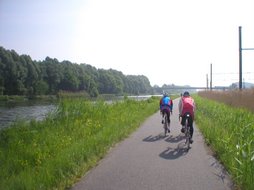
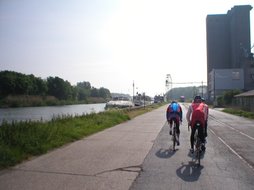
Today was another recovery day, used to spin out the legs and attempt to get them back to racing conditions. We waited for a gap in the rain and then proceeded on a long ride following the canal and local villages. By the end of the ride we somehow found ourselves in another coffee shop. We were treated to an English speaking waiter (well, he tried to speak English), and once he figured out that we were American we were lucky enough to hear his stories about Greg Lemond. This guy was apparently at the TT where Lemond beat Fignon to win the Tour. He gave us a full lecture on how strong Lemond was, and how he was the first to use TT equipment. He didn't really mention anything else, but his stories were long enough to take us through two cups of coffee. Once a gap in the rain appeared, we wound our way back to the house.
Subscribe to:
Posts (Atom)